
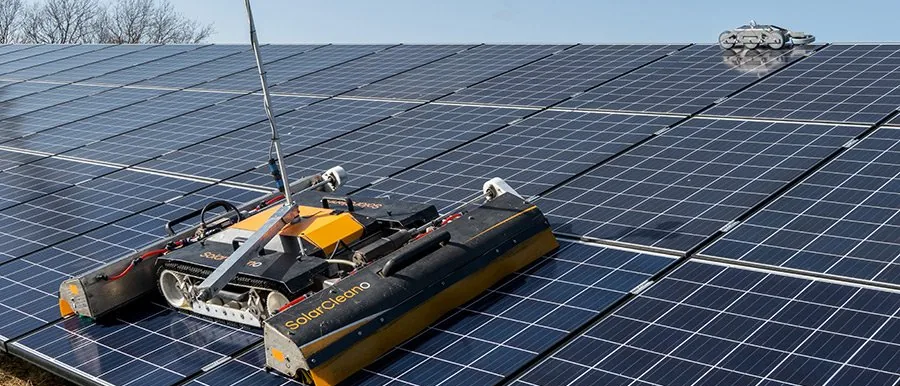
We sell robotic cleaning, so treat what follows with the scepticism it deserves — and then notice that we send people, not machines, to a good number of our sites. Robots are not a better way to clean a panel. They are a better way to clean certain panels, and knowing which is most of the skill.
Not a straight verdict
The marketing version of this comparison puts robots ahead on every line. The real picture is narrower. A robot wins decisively on consistency, water and safety. It loses on flexibility, mobilisation cost and anything involving an irregular roof. On a twelve-module terrace array, sending a machine is theatre.
Consistency
This is where machines genuinely win, and it is the reason we use them. A brush on a controlled traverse applies the same pressure to row forty as it did to row one. A person with a pole at the end of a shift in May does not, and no amount of supervision changes that. On a large array the last rows are reliably the worst-cleaned ones, and they are usually the rows furthest from where anyone stands to inspect the work.
The argument for automation here is not speed. It is that the hundredth module gets the same treatment as the first.
Water
Manual cleaning with a hose is the single biggest water waster in solar O&M. Volume is set by how long someone holds the trigger, which is set by how much of a hurry they are in. Metered delivery through a machine uses roughly 30% less water than conventional manual methods on our sites, and more importantly it uses a predictable amount, which matters when the plant is in a water-stressed district and the tanker is a line item.
Two cautions worth stating plainly. “Waterless” robotic systems exist and work well on fine dry dust, but they do not remove droppings, cement splatter or anything that has bonded to the glass. And water quality matters more than volume: hard water applied by a machine still leaves scale.
Safety
The strongest case for robotics is not commercial. Work at height on a surface designed to carry snow load, not people, with water underfoot, is the most dangerous routine task in this industry. Every array where a machine does the traversing is an array where nobody is standing on a wet module at 11 a.m. in June.
On steep pitches, fragile roof sheets and anything above two floors, this alone decides it for us.
Damage to the modules
Most cleaning damage is invisible on the day it happens. Foot traffic introduces micro-cracks in the cells that show up months later as underperforming strings. Dry wiping drags grit across the anti-reflective coating and permanently dulls it. High-pressure jets push water past the frame seal, and the resulting moisture ingress is not a cleaning problem any more — it is a warranty conversation.
A machine avoids the first of those by design. The other two are method problems that a badly configured machine reproduces perfectly well. Ask what pressure and what water, not just what equipment.
What it costs
Per square metre, on a large regular array, a machine is cheaper once you account for the crew size it replaces and the water it saves. On a small or awkward site it is more expensive, because mobilising equipment has a fixed cost that does not shrink with the job.
The number that actually decides it is cost per unit of recovered generation, not cost per clean. A cheaper clean that leaves the bottom frame edge dirty is not cheaper.
Choosing for your site
- Large ground mount, regular rows: robotic, comfortably.
- Big commercial rooftop, uniform tilt: robotic, with people for edges and obstructions.
- Mixed-tilt or obstructed rooftop: semi-automatic — a powered brush on an arm, operated from a safe standing position.
- Steep, fragile or high-risk roof: robotic, for safety before economics.
- Small residential array: trained people with the right water and the right brush.
Most real plants end up with a combination, which is why we run autonomous, semi-automatic and manual methods rather than picking a side. The method should follow the roof. If a supplier recommends the same equipment before seeing your site, they are selling equipment rather than solving your problem.
Related: Cleaning frequency · Our technology